Tuesday, November 10, 2015

And Even more on PE Tankcars

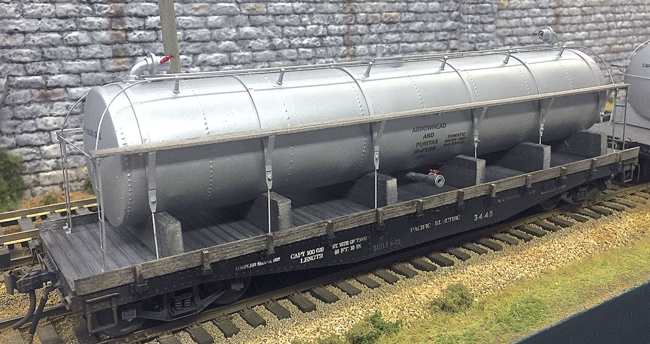
So, this series of Tank Cars are what I am looking for.  Built on the Southern Pacific F50-4 flat car, you can see in this image that this could be a pretty straight forward build if you had a lot of spare parts.  I'll be digging through my stash to see if I have the components to bash this up.  As a starting point I think the easiest way to go is to use the Tichey Train Group 40' Flat Car with some additional details, namely the wood bracing between the stake pockets that can be simulated using Evergreen Polystyrene strips.  Deck will need to be sectioned on the ends and new supports built.  I looks as though a 10,000 Gallon tank car cut down in length will work for the tank.  Difficult parts will be the strapping, walk supports and of course the handrails and handrail stanchions.  I figure painting will be the easiest part. 
Tichey Flatcar 
Tichey Tank Car

For the Tank, again turning to the PE Modelers best friend, Tichey makes a nice kit that has the parts you need, but two will be required.  Hopefully you can buy sprue's of the parts and not have to give up a whole tank car just for tie downs and stanchions.  More on that later.   If done right this car will be a nice addition to a standard consist, mixing in a few ACF 8,000 Gal Tank cars in for later service.  The included photo was shot in 1941 so they may have lasted into the 50's...well, at least on my railroad they will.  This is too good a shot of a car necessary to at least not try and capture.

Monday, November 9, 2015

A little more info on Tank Cars

So in my last post I talked about the tank cars used for water service at Arrowhead.  I have been contacted by a fellow modeler who may have drawings I can use of the flat with a single tank fitted version seen during the 30's - 50's.  Hopefully I will have those to post at some point.  In the mean time, what looks to be an easy project involves combining a 40' flat car with stake pockets removed and a 8-10,000 gallon tank mounted on top.  PE fielded tank cars and at the moment I am not sure how many of what they had.  This photo is a great illustration of this project:

Granted, this photo makes it look like a longer car, but according to the ORER's of the era as late as 1956 list the flats as being 42' long and have an extreme height of 12'9".  Both Tyco and Athearn both make cars that would be a good starting point, dressed up with some Tichy Train Group details and a Lifelike/Proto 10,000 gallon tank car for the load.  You will need to shorten the dome and add a few vent details but when finished, will make an interesting car.  Colors are anyone's guess but I have a few resources to check out.  I figure the car is either black or a standard red/brown, lower section of the tank black and the upper silver.  Lettering would probably be black.

ORER notes the series runs from 7314 to 7319 by 1956 most likely more early in the 20th Century.

Here is a shot late in tank car water service; a single tank car being pulled by an SW switcher making for a nice short consist for space challenged layouts.

Here is an update:  Reviewed the 1926 and 1938 ORER and came up with this additional Information.


Monday, November 2, 2015

PE Arrowhead Water Route

Well, my plans for world domination have been on hold awhile, but now with a nice kick in the pants opportunity to design new "Freemo" modules for our HO club, I think I can start moving forward.  Currently the club has the older two rail lumber rich modules most are familiar with.  Most of the modular systems were designed to have two or three rails at the front side of the module with a huge blank space in the rear for what ever you could cram in there.  I never liked the concept and until Freemo became standardized hadn't considered doing much more than my own system that could fold into a home layout sometime in the future.  Basically, Freemo has a single rail that starts and ends at the center of the ends of the module.  Generally 24" wide they can be any length given the returns are reverse loops.  These are designed to both run and operate like a real railroad having engines running in both directions.  Check it out on line, plenty of info there. Free-mo site

More to the mission at hand, I am building three modules for the upcoming show.  Our internal standard will be 18' wide with adapter sections 24" for working with other clubs.  The one I plan on keeping will be a simple straight section with a road crossing that will be modeled after the location of a PE Relay station.  This is a picture of a part of the Eastern Section of PE on the way up to the Arrowhead Water facility.

Not the most lush of locations, but with the crossing and the power poles and other details, will make an interesting module to photograph on.

Here is a shot of the structure in the distance.

Arrowhead Water operations could be a whole other very interesting PE operations layout point to point.  History  The terminus was a deep canyon to the north of LA where the natural springs were located.  The mountain side had a huge Arrowhead rock shape on it's flank which was the origin of the springs name. The area had a loading spur, a few structures and beyond it a resort that would be too far away to model.  The track wound down to the city were the actual bottling plant was located.  Here are a few illustrations of what it looked like in the 20's, what I think is a worthy modeling project.

This is from the track side, glass lined tanks on flats were shoved into the end spur and off loaded.  For those fortunate enough to have one of the Metro Models three flask Flat Cars, this would be a nice companion for it.  So far any searches for photo's of the model have come up empty.   Later they went to the more standardized ACF style tanks, none that I can find labeled Arrowhead specifically.


Above are some shots I found on line of a brass model which will really help when I get around to scratch building them for my layout.

Decal at one time produced by Custom Traxx Decals...still available but in short supply.  I think I will grab a few of these for my library and also to apply to an ACF 8,000 Gal tank car model as a fudge given the glass flats are too old for my modeling era.


Here is an old postcard I found on line showing the other side of the plant.  Possibly just the loading side could be modeled  with the sign to represent the building.

Back up in the hills, you can see a PE 44 Tonner holding a tank car being filled behind it.  I'm currently looking for more information on the site, but it looks to be a pretty simple transfer location.


Here is a sample model built for a lecture about making the Arrowhead Tank Car Model.  This makes things a lot clearer...which I could attend the class.


Big time score during my hunt for allusive Arrowhead Tank cars.  Still researching the scheme but WOW
A nice home built version, looking like a straight forward kit bash...need to look more at this one.
Here's a model I found on line.  Length of the tank is off, but nice to see something.


As for delivery, it depends on your era, but here is a cool shot of a 40's vintage truck you could build using a cab and chassis from a Mini Metal Works truck.


How about a series of road signs?

These lattice work billboards scream period..

Some images from the 100th anniversary of Arrowhead
At some point I'll get this part of the blog set up as a more cohesive post.  I reached out to the Pacific Electric Facebook page and these images appeared.  My modeling White Whale finally arrived!  Very excited about getting this kind of information that will allow me to finally model the scene.


the holy grail of Arrowhead water loading.  LOL  Given the information I was able to do a quick model of the water pipe in preperation for a full blown 3D model I will print.  The site had two tracks, one for loading and the other for staging I suppose and had three stations.  Combined with some overhead shots I have a basic idea of what the area was like and how to model it.


The stand was turned out of steel rod stock with brass and styrene.  Funny how such a small detail can become such a big deal.  


Monday, October 26, 2015

Station Drawings

One of the iconic stations for the PE/SP is available as a kit in HO scale. Here is a drawing of the front of it. Bruce Petty has one build and I have been able to shoot a few beauty shots of my engines in front of it. Showcase Miniatures PE/SP Depot Link makes the model and while it is big by most HO standards, it can make quite a nice dio that makes great use of available space. While not located anywhere near the Orphan Spur, it is a must to add to my shelf of unrelated structures.

Station on Bruce Petty Layout

Critter Decorated

Now that I finally have the 35tonner in hand, I spent an hour on Saturday installing decals I made on my Alps to represent the loco in prototype. There are a number of physical differences between the proto and the model, but with a little bit of color here and there it makes a great stand in. I ran this around the club layout and was able to pull 4 cars and a caboose up and down 1% grades all day. Great little engine.

Tuesday, September 1, 2015

Scanning the PE Roster for Reference

PE 1647 Near Reality.

Good News! Modeling a short spur of a larger railroad is generally not much of a problem. Common equipment may have flowed on and off the line depending on need. On the Orphan Spur two switchers were used, the 44-Tonner which can be modeled using the new Bachmann model in both HO or N scale, and the Plymouth 35 ton switcher that has been difficult to model. In N scale we have the old Bachmann Plymouth but has the bulky look and can be modified for the part. In HO the same model was available, but given the size, a real stretch to make into an acceptable version. I attended the latest National Train show and got to see up front the new Broadway Limited Plymouth 35 ton switcher and it is very close to the elusive PE 1647 that was used on the spur during the time I am modeling. Here's a shot of the model. The are producing it in just about very scheme possible save PE of course! No problem. Micro Scale Decal sheet 87-590 has all the bits and pieces you need to model the engine.
Here are a few shots of 1647 in action on the turn I am modeling.
You can see some of the differences, but given the proto and my unwillingness to spend a lot of time counting rivets, this will work out just fine. It has the wheel set and the look for a good enough sample of the real thing. So far I haven't found shots of the rear end of the engine, hoping it has the broad window glass of the proto. Edit, here is a shot of the rear of the model...not as open as the proto...I may need to address this.